Case study
Student participation and rewards
A society directory and mission cards that show students exactly what to do and what they'll earn.
Before: voluntary participation - Find club through campus channels
- Choose to join or attend
- Participate in activity
- No redeemable reward
Fig. 1 Only 6% took part
Student-union data showed about 6% of students joined extracurricular activities.
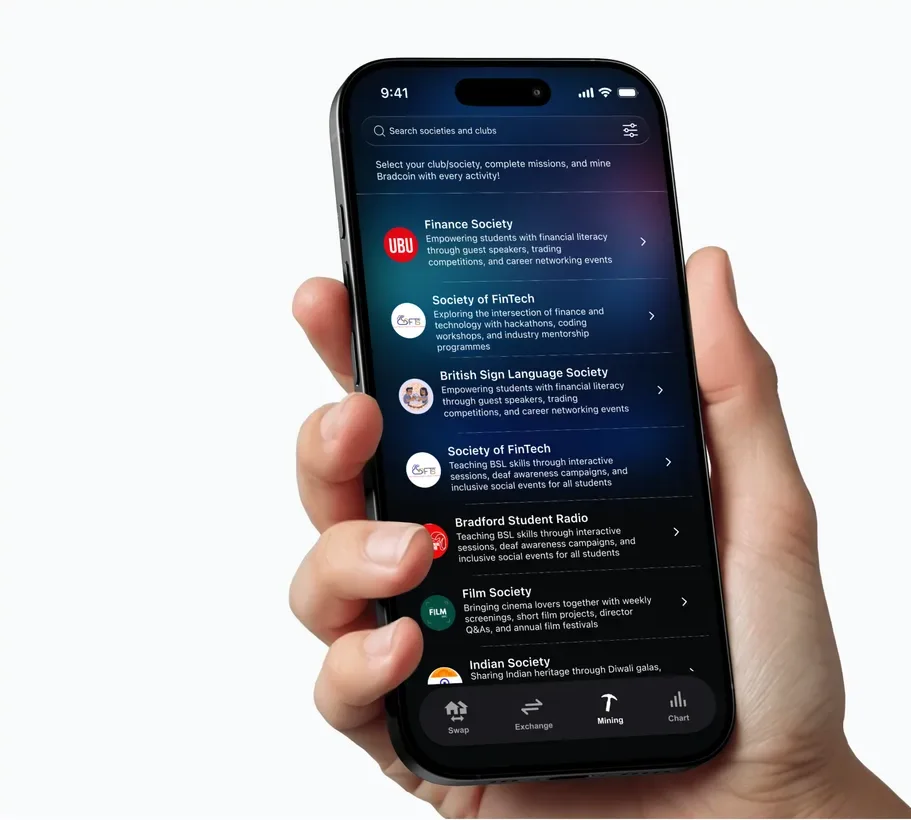
Fig. 2 Start with names students know
Discovery begins with a searchable directory of real societies, not an abstract rewards menu.
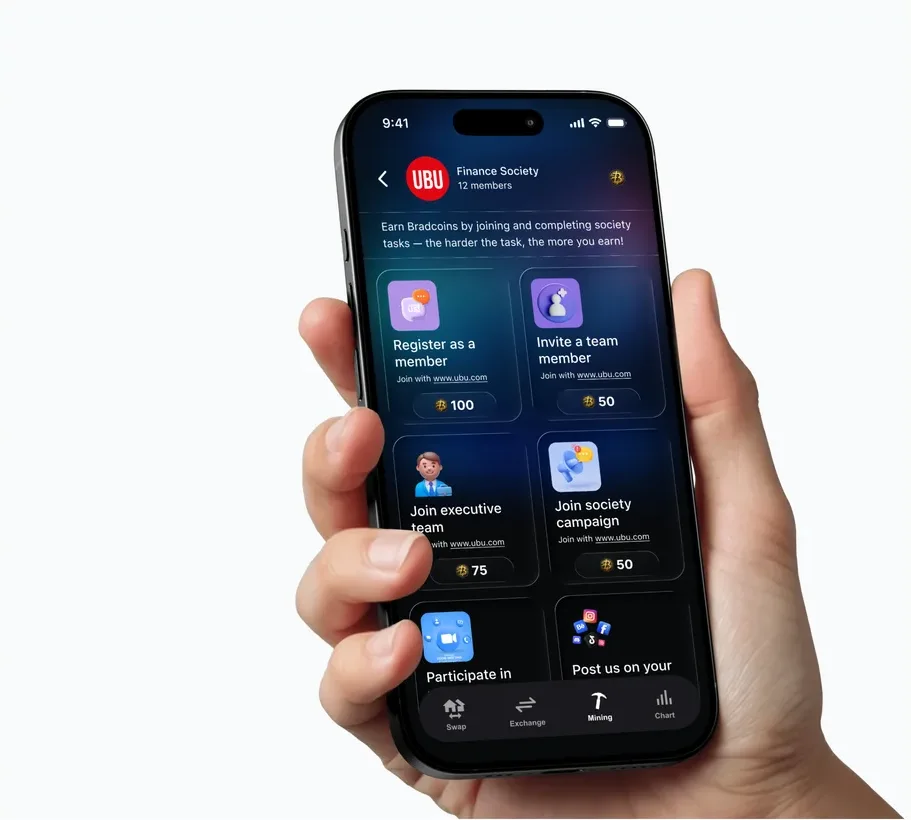
Fig. 3 Make the reward concrete
Each society lists specific missions, like joining, inviting or taking part, each with a visible token reward.
Fig. 4 Earned, not promised
Tokens are credited only after participation is verified, and pending rewards look different from ones ready to spend.
After: earn through verified activity - Register and link wallet
- Find society in Mining
- Choose and complete activity
- Verify participation
- Allocate Bradcoin reward
Fig. 5 The new flow
Register, find a society, complete an activity, get verified, receive Bradcoin.
Fig. 6 Led end to end
I led a team of four, designed the app and wrote the whitepaper.
Read the full write-up
Problem
Student-union statistics showed only about 6% of students took part in extracurricular activities. Low participation limited the reach of clubs and societies, and students' chances to build skills through campus life.
The design had to make activities and their incentives understandable, while making sure rewards depended on verified participation. Discovery alone wouldn't complete the earning journey.
Hypothesis
If students can discover societies, see specific activities and understand the rewards attached, they'll be more likely to take part.
Linking tokens to verified activity makes the incentive traceable, and campus redemption gives it a practical purpose. The hypothesis is about participation and continued engagement — not speculative interest in a token.
Goals
- Increase extracurricular participation and connect campus involvement to rewards students can use.
- Project-level ambition: raise participation from about 6% to 50%.
Measured by: Society-discovery task completion, progression from viewing a mission to verified participation, and successful reward allocation — with repeat participation tracked separately.
What I did
- We used student feedback and engagement analysis to shape the activity and reward model. Ali ran and analysed surveys supporting the mining tasks and feasibility.
- I designed the mobile interface around society discovery and mission selection, connecting the visible earning experience to the registration, verification and token-allocation workflow.
- The team refined the mining model and app flow together through brainstorming, testing, re-testing and reviewing each other's work.
My role
I led the project, designed and developed the mobile app interface and wrote the full whitepaper — connecting the product narrative and system workflow with the student-facing experience.
Ribin designed the logo and co-developed the app. Ali led student research and engagement analysis. Sarah reviewed regulatory, privacy and ethical considerations.
Solution
A searchable society directory leads to a page of activities for each society. Mission cards pair specific actions with visible token rewards — registering as a member, inviting someone, joining a campaign.
Rewards are allocated after participation is verified, and the interface shows available activities and potential rewards before students choose what to do.
Key decisions
- Start discovery from recognisable society names and a search box.
- Show missions as individual cards with an action and a reward value.
- Tie reward eligibility to verification, and show “awaiting verification” separately from tokens ready to spend, so choosing a mission never looks like an instant credit.
Trade-offs
- A general “get involved” appeal communicates value but leaves the reward vague. Activity-specific missions make actions and incentives explicit.
- Incentives can encourage reward collection rather than real participation. Verification handles eligibility; repeat attendance and meaningful involvement are what to examine for long-term value.
Validation plan
- Survey interest and team testing gave evidence for the concept — not yet post-launch participation growth.
- Feature validation: students find a society, identify an activity and its reward, and explain what must happen before tokens are credited. Interrupted handoffs, pending verification and rejected participation are tested as separate scenarios.
Outcome and next steps
Delivered the mobile interface, whitepaper, activity-based reward model and a workflow linking participation to token allocation. The project was featured in The Telegraph and adopted by the university as a teaching benchmark.
The 6% baseline and 50% objective describe the intended change; claiming it would need verified participation data after implementation.
The earning experience had to explain both what students could do and how that activity became a reward. Discovery and mission cards handled the first part; verification and allocation the second.
Next, I'd make the transition between those stages explicit — especially when students leave the app to do an activity and come back before the reward is ready.